The City clears a three-metre driveway opening within about two hours of plowing a residential street, and on collectors and arterials when the windrow is over 25 cm.
It opens a gap in the ridge. It does not clear your driveway.Seasonal contracts are booked in September and October
Snow clearing and ice management
The city clears the ridge. It does not clear your driveway.
Every city on this corridor tells you, in its own words, that its windrow service is partial. That gap between the ridge being opened and the driveway being usable is the entire residential snow business, and it is the part people discover in January.
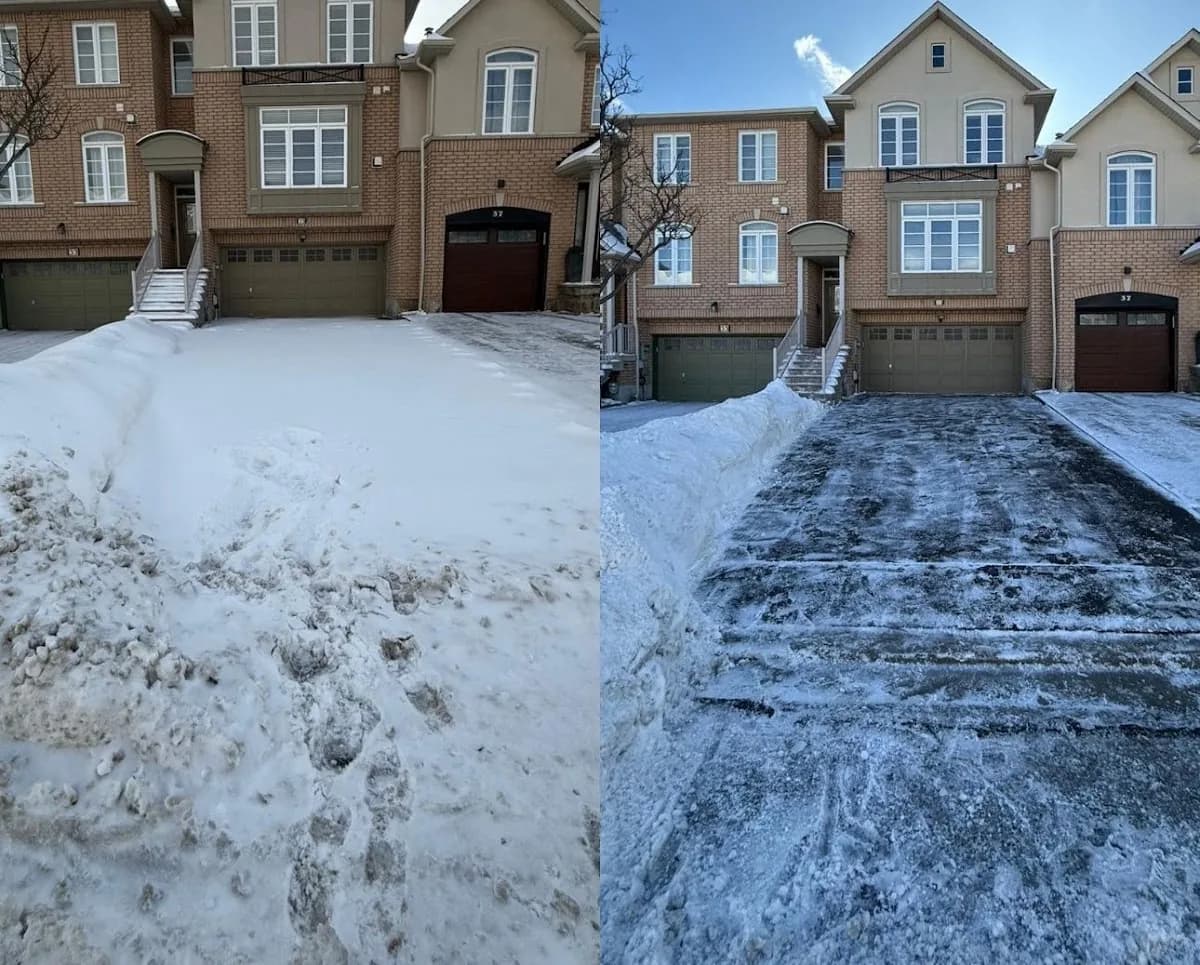
A packed, rutted driveway and a buried walkway, cleared to the pavement with the snow stacked on the property and the walking surface treated. See how it was done
What you are actually buying
What the work
includes.
No packages, no tiers. This is the work itself, and anything on your property that does not need doing will be said so at the quote.
- Cleared to the surface, not to a levelThe pack comes off down to the pavement. Leaving a compacted base is how a driveway becomes an ice rink at the next thaw and freeze.
- The walkway and the entrance as their own taskThe route people actually use, cleared properly rather than as spillover from the driveway. Steps and landings included.
- The sidewalk-plow windrowThe ridge the sidewalk plow leaves across your driveway is explicitly the homeowner's responsibility in Vaughan, and in practice everywhere. It gets cleared.
- Snow stacked on your propertyBanked where it will not block sight lines out of the driveway and will not slump back across the cleared surface as it melts. Pushing it to the road is an offence in all four cities.
- Treated after clearingCleared surfaces get material on them. Under Toronto's by-law that is an obligation on the owner, not a courtesy, and it is the step that decides whether the clearing holds overnight.
- Salt kept off what it killsRates controlled and applied before freezing rather than after, and kept away from cedar hedges and lawn edges where the damage shows up in April.
Timing
Why September and October
Seasonal routes fill before the first snowfall. The properties that get reliable service in January are the ones contracted in the fall, because a route is planned geographically and there is no room to bolt on a distant property in a storm.
Richmond Hill's windrow opt-out closes in mid-November, and Markham's registration only ever covers residents aged sixty or over or with a disability. Knowing which applies to your address changes what you actually need from a contractor.
Winter parking rules start on fixed dates. Richmond Hill bans on-street parking from 1 December to 31 March. Vaughan and Markham prohibit it overnight year round. Where the snow goes has to be planned around that.
The gap nobody mentions
What the city
does not do.
These are the cities' own descriptions of their windrow service. Read together, they are the clearest argument for hiring anyone at all.
Vaughan clears driveway windrows city-wide, generally within about four hours of the plow passing.
Vaughan says plainly that the machines clear only a portion of the entrance, that residual snow will be left, and that the windrow left by the sidewalk plow across your driveway is the homeowner's responsibility.Markham clears windrows within about four hours of the street being plowed after snowfalls of 7.5 cm or more, but only for registered residents aged 60 or over, or with a disability. Roughly eight thousand homes qualify.
If you are not on that list, the ridge across the end of your driveway is entirely yours. This is the biggest service gap of the four cities.Richmond Hill clears windrows at more than fifty thousand residential driveways, starting about two hours after the road plows go out. Residents opt out rather than register, with a deadline in mid-November each year.
The City aims for one car width and states it does not clear to bare pavement.Questions
Worth knowing
before you book.
Doesn't the city already clear my driveway windrow?
Partly, and only in some places. Toronto and Vaughan clear windrows automatically, Richmond Hill does city-wide with an opt-out, and Markham only for registered residents aged sixty or over or with a disability. Even where it happens, the cities are explicit about the limits: Vaughan says residual snow is left and the sidewalk-plow windrow is yours, and Richmond Hill says it does not clear to bare pavement.
Can you push the snow onto the road?
No, and nobody legitimate will. It is an offence in all four municipalities under their own by-laws, and separately under Ontario's Highway Traffic Act. Cleared snow has to be stored on your property, which is why storage space gets discussed at the quote and not in February.
Will salt damage my cedars and my lawn?
It can. On evergreens the damage comes mainly from spray rather than from salt in the soil, so a physical barrier between the driveway and the hedge is worth more than any soil treatment. On turf, fine fescue tolerates far more salt than the Kentucky bluegrass most GTA lawns are built from, which makes overseeding the driveway edge a genuine fix. Gypsum is not a general cure and can make the wrong soil worse.
What happens on a small snowfall?
Cities do not roll for everything. Toronto mechanically clears most public sidewalks once accumulation reaches 2 cm, and the twelve-hour clearing duty on the owner bites below that. Markham starts local roads at 7.5 cm. The small events are the ones that catch people out.
WhereSnow clearing and ice management across Toronto, Vaughan, Markham and Richmond Hill. Which city you are in changes the rules, and the quote accounts for it. See every area we serve.
Seasonal contracts are booked in September and October
Book your snow and ice.
Send your postal code and a few photos. I'll confirm the scope, tell you which city's rules apply to your address, and give you a straight number.