The lots
Uneven street to street, because of the forty-year build span. Tree maturity and lot geometry can change noticeably from one block to the next.
Toronto · M2M · M2R
Newtonbrook sits on the tableland between the east and west branches of the Don, which means valley edges bound it on both sides while the interior stays flat. It is also the one neighbourhood here where storey-and-a-half houses are a genuine local marker.
Steeles to Finch, Bathurst to Bayview
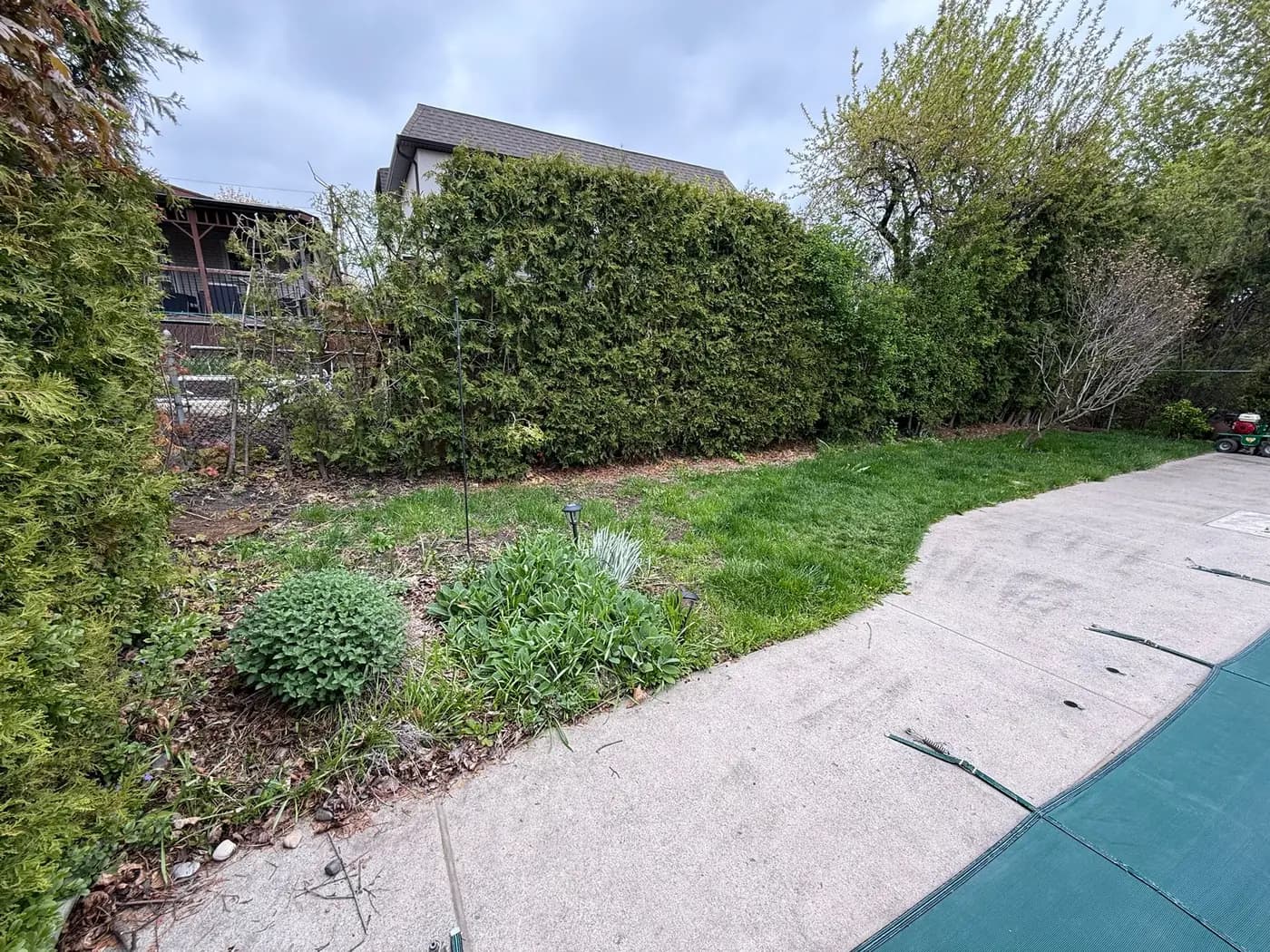
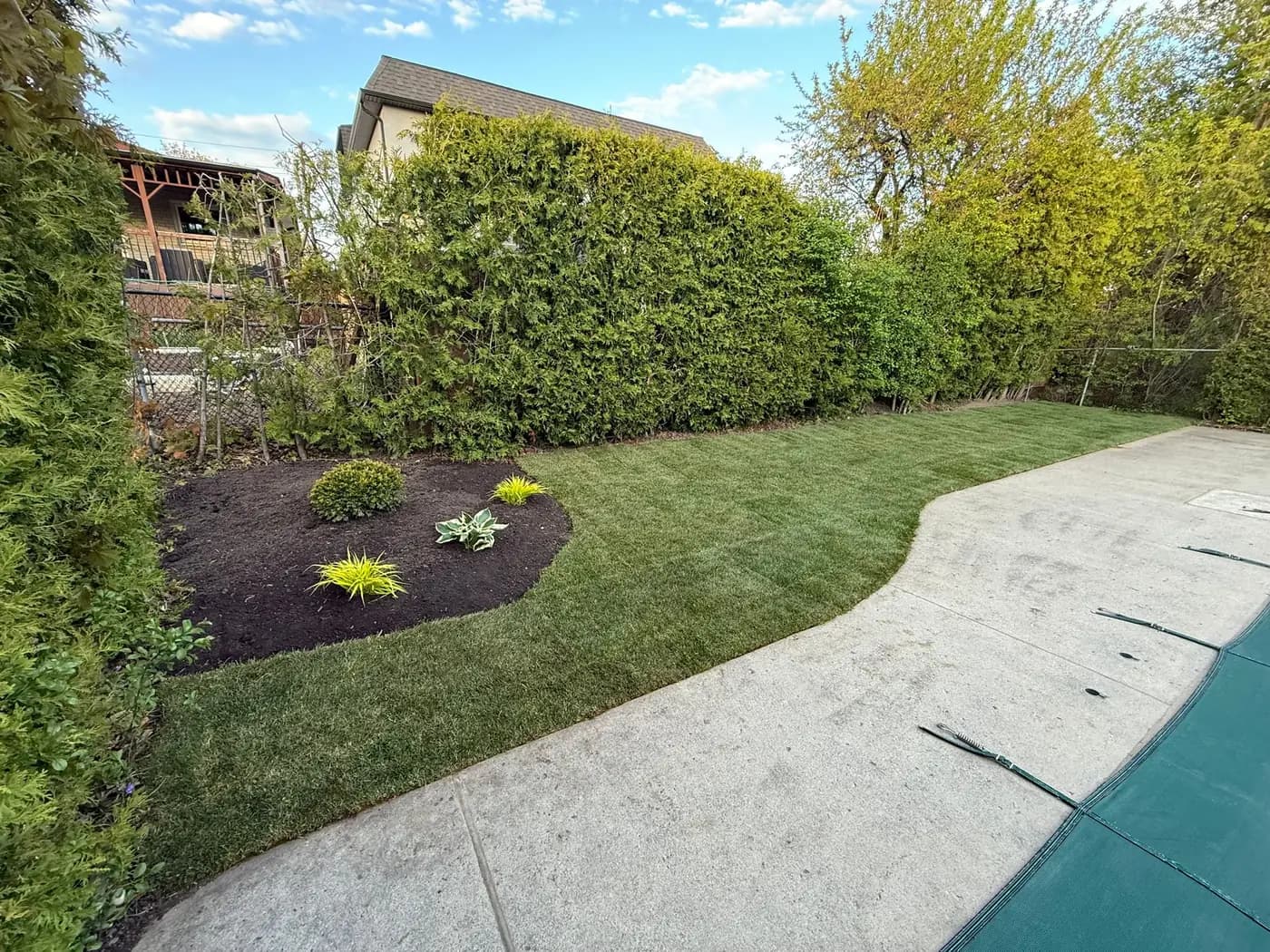
A mature cedar hedge running the length of the yard, with a ragged strip of weeds and leftover perennials at its base. Given a proper curved bed, new planting and a clean edge to the concrete. See how it was done Real Orbit work across Toronto and York Region. Not stock, and not a render.
Uneven street to street, because of the forty-year build span. Tree maturity and lot geometry can change noticeably from one block to the next.
Original stock spans the 1920s through the 1960s, with heavy 1950s development that removed most of the historic village. Split-levels, storey-and-a-half houses and bungalows, with growing numbers of custom rebuilds.
Over twenty neighbourhood parks, framed by the east and west Don branches and the Finch Hydro Corridor.
Flat interior lots make snow storage straightforward. The valley-edge streets are where access and stacking need thinking about.
What actually changes the work
Every one of these is a real constraint on Newtonbrook properties, not a sales angle. Knowing them before the quote is the difference between a job that holds and a job that gets redone.
A property four streets from the valley falls under the ordinary 30 cm tree threshold. A property on the valley edge falls under the ravine by-law, where every tree is protected and grade work needs a permit. The map is checked before the quote.
A 1920s house and a 1960s split on the same street carry completely different tree loads, grading and drainage. Pricing by street average does not hold up here.
The rules that actually apply
Newtonbrook is in the City of Toronto. The thresholds below are that city's, and they are not the same as the city on the other side of the boundary.
A permit is needed to injure, destroy or remove any private tree 30 cm in diameter or more, measured 1.4 m above ground. Injury includes failing to protect a tree properly during work, so root-zone compaction and regrading count. Penalties run from $500 to $100,000 per tree.
Toronto Municipal Code Chapter 813, Article IIITurfgrass must be cut once growth passes 20 cm. The same by-law requires properties to be kept clear of prohibited plants, and the named list is exactly what colonises a ravine edge: dog-strangling vine, garlic mustard, common and glossy buckthorn, Japanese knotweed, phragmites, giant hogweed, purple loosestrife, poison ivy and ragweed.
Toronto Municipal Code Chapter 489No owner or occupant may move snow or ice from private property onto a road, sidewalk or laneway. Sidewalks adjoining the property must be cleared within 12 hours of snowfall ending, and driveways, steps, walks and landings within 24 hours.
Toronto Municipal Code Chapter 719The City mechanically clears the large majority of public sidewalks once accumulation reaches 2 cm. Below that threshold the 12-hour clearing duty sits with the owner.
Soft landscaping on the City boulevard needs no permit, but boulevard trees are City property and are protected at any size.
Before any quote
This neighbourhood genuinely straddles both conditions. East and west valley-edge properties are ravine-regulated; the interior tableland is not. Address-by-address verification matters more here than almost anywhere.
Around NewtonbrookWe work regularly near Drewry Avenue, The Newtonbrook Schoolhouse, Centerpoint Mall and Cummer Avenue.
Newtonbrook quotes
Send your postal code and a few photos. I'll confirm the scope, flag anything that needs a permit, and give you a straight number.